
Research
My current work focuses on the development of a research framework called Wearonomics, which validates wearable-derived data through transparent, rule-based analytical systems, and links verified activity to economic attribution models. This work is supported by a functioning laboratory environment and real-world datasets.
The underlying hypothesis is that combining transparent validation with incentive mechanisms may increase consistent device use, resulting in more reliable longitudinal data for public health research.
Research Paper

Current Research | FAQ
-
Wearonomics is a research framework that validates wearable-derived data through transparent, rule-based systems and links verified activity to economic attribution models. It transforms raw wearable signals into structured, interpretable outputs that can be traced, analysed, and consistently reproduced.
The framework is designed to address a fundamental issue in wearable data: the presence of data does not guarantee meaningful activity. By combining validation with attribution, Wearonomics creates a system where only genuine human behaviour is recognised and translated into measurable value.
-
The core idea is that wearable data should not be treated as inherently valid. Instead, it must be verified through transparent logic and only then translated into meaningful outputs.
By introducing economic attribution after validation, the framework creates a system where verified behaviour is both measurable and structured, enabling new ways to study data quality, engagement, and system design.
-
Economic attribution is the process of assigning measurable value to validated wearable data. Activity must first pass through strict validation rules before it can generate value within the system.
This ensures that value is not linked to raw or unverified signals, but only to activity that can be explained and reproduced. The result is a controlled system where validation and value are directly connected.
-
Wearonomics uses deterministic, rule-based systems to evaluate whether recorded data reflects genuine human activity. This includes analysing movement patterns, continuity, speed ranges, and other measurable characteristics.
Only data that satisfies all validation conditions is accepted. This creates a clear distinction between recorded activity and verified activity, ensuring that all outputs are grounded in reliable inputs.
-
Unlike many wearable data systems that rely on probabilistic models, Wearonomics prioritises transparency and reproducibility. Its validation logic is explicitly defined and can be audited step by step.
This approach ensures that every output can be traced back to its input conditions, which is essential for research environments where interpretability and accountability are critical.
-
Wearonomics Lab is the research and development environment where the framework is built, tested, and executed. It integrates cloud infrastructure, data pipelines, and analytical tools to support the development of validation engines and attribution systems.
The lab acts as the operational backbone of the framework, enabling real-world experimentation and ensuring that all results are reproducible and traceable.
-
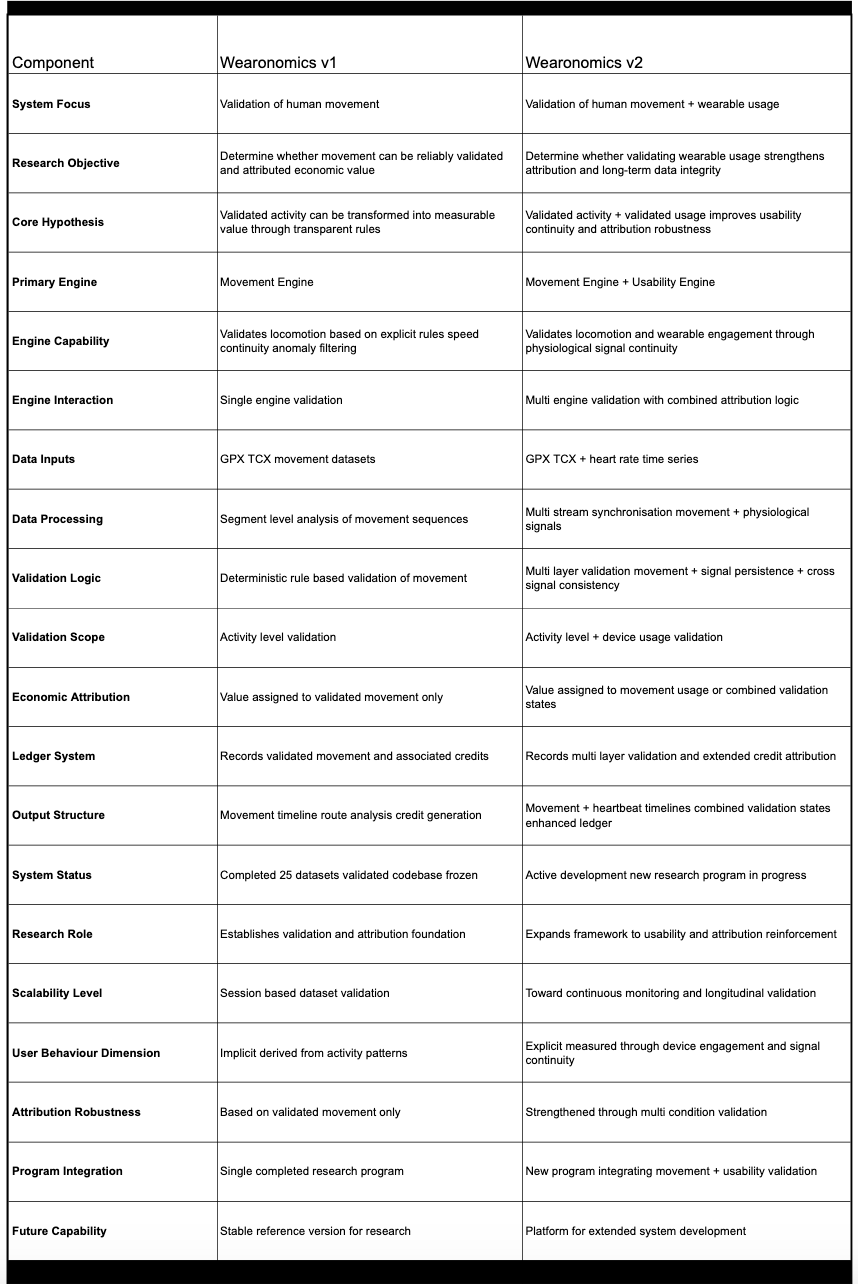
Wearonomics v1 is the first completed implementation of the framework, focused on validating human movement and assigning value to verified activity. It establishes the foundational system and has been tested across real-world datasets.
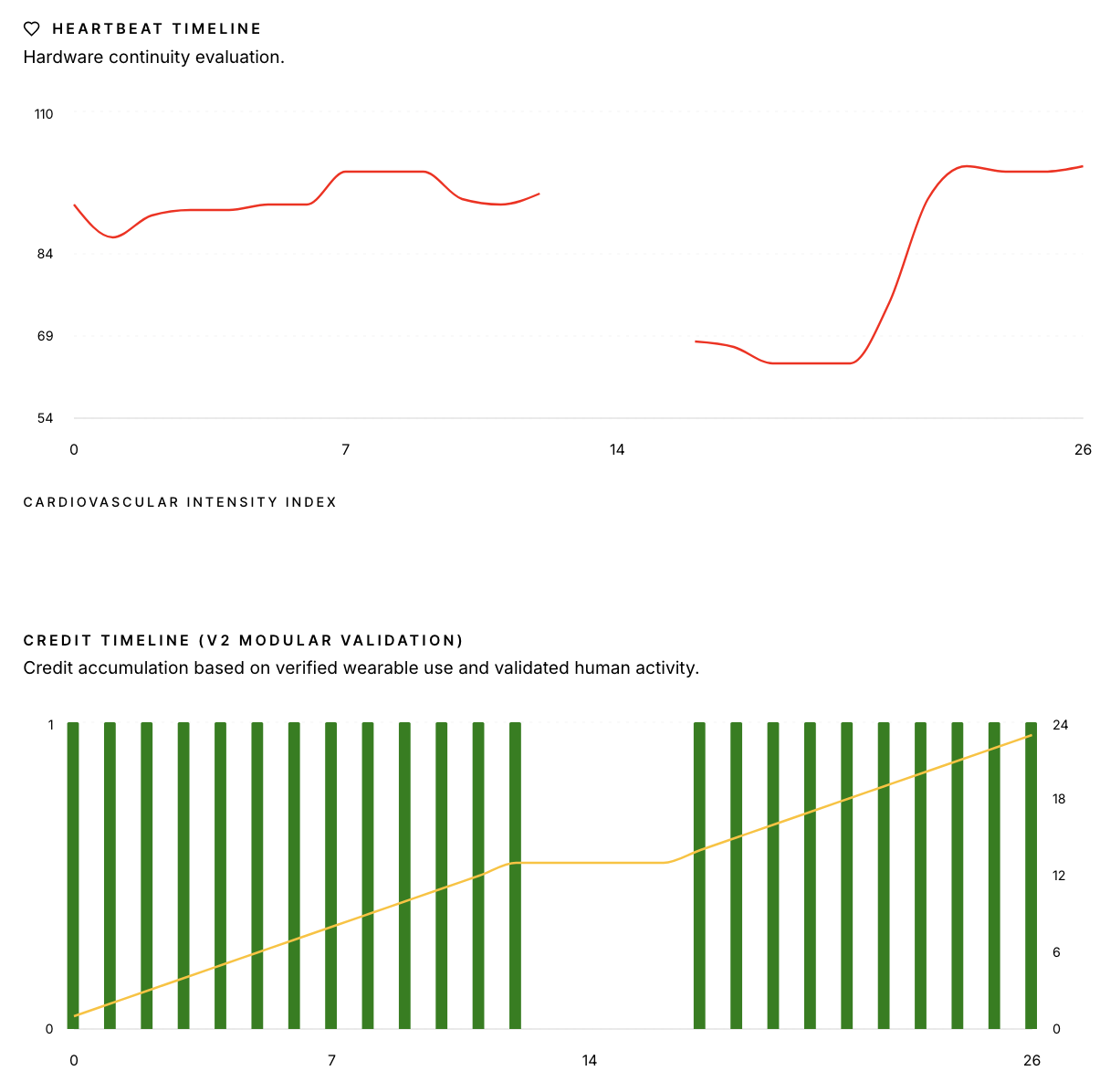
Wearonomics v2 extends this by introducing wearable usability validation. In addition to movement, it evaluates whether the device is being consistently used through physiological signals such as heartbeat continuity, strengthening the attribution model.
-
In v1, economic attribution is applied to validated movement only. Value is generated when activity satisfies the validation logic.
In v2, attribution is extended to include wearable usage. This means value can also reflect sustained device engagement, creating a more comprehensive system where both activity and usage contribute to the overall attribution structure.
-
The ledger is the structure where validated activity and its associated value are recorded. It provides a transparent and cumulative representation of attribution, allowing each unit of value to be traced back to the original data.
This ensures that the system remains auditable and that all outputs are directly linked to validated inputs.
-
A central hypothesis of Wearonomics is that economic attribution may influence how individuals use wearable devices. By linking validated data to value, the framework creates conditions where consistent and genuine usage becomes meaningful.
This allows the research to explore whether value-based systems can improve adherence, increase engagement, and support more reliable data collection.
-
Wearonomics is not primarily a monetisation system. Its focus is research. Economic attribution is used to represent value within a controlled analytical framework, not to create immediate financial products.
However, the structure allows for future exploration of incentive-based models where validated contributions could be linked to compensation.
-
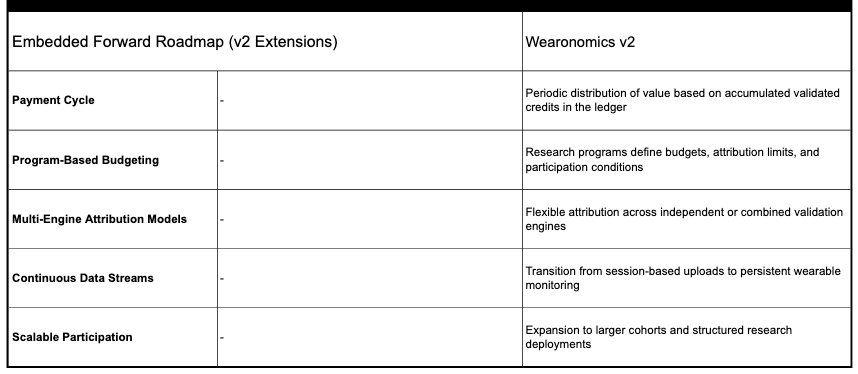
Future versions of Wearonomics may include payment cycles where accumulated credits in the ledger are periodically converted into compensation. These payments would be strictly based on validated activity and usage.
This would allow the framework to test real-world applications of economic attribution while maintaining control over data integrity and validation standards.
-
By improving the reliability of wearable data, Wearonomics supports more accurate analysis of physical activity and behavioural patterns. Validated datasets provide a stronger foundation for population-level research.
The framework also explores whether incentive-based models can improve long-term wearable usage, which could enhance data continuity in public health studies.
-
Introducing value into data systems can create incentives for manipulation or unintended behaviour. If not controlled, this could reduce data quality.
Wearonomics addresses this risk by enforcing strict validation rules before attribution occurs. Only verified activity can generate value, reducing the potential for gaming the system.
-
The long-term vision is to create a scalable framework that supports validated data collection, transparent analysis, and structured attribution across large populations.
By linking validation with economic representation, Wearonomics aims to enable new models of participation where individuals contribute high-quality data in exchange for structured and controlled recognition, supporting both research and broader societal applications.
Research Programs
Wearonomics v1
RP1 — Validated Human Movement and Economic Attribution
Core research question
Can wearable movement data be validated as genuine human activity under real-world conditions, and can that validated activity support transparent economic attribution?
Abstract
This research program represents the continuation of the initial study that led to the development of the Wearonomics research paper. It evaluates whether wearable-derived movement data can be reliably validated as genuine human activity under real-world conditions and whether such validated activity can support a transparent model of economic attribution. Using the Wearonomics Movement Engine v1, a rule-based validation framework was applied to a set of up to 25 real-world datasets, segmenting activity into validated movement, pauses, artefacts, and transport through explicit and auditable criteria.
Across the datasets, the system consistently identified physiologically plausible movement while excluding non-qualifying segments, demonstrating that rule-based validation can produce stable and interpretable classifications without reliance on opaque models. Validated segments were preserved within a temporal ledger, enabling the proportional attribution of value exclusively to activity that satisfied the validation logic.
The results across these datasets confirm that wearable movement data can be transformed into a reliable and structured signal when processed through transparent validation rules. The integration of a ledger-based attribution model establishes a direct link between verified activity and measurable value, supporting the feasibility of economic attribution grounded in validated human behaviour.
These findings should be interpreted with consideration of practical limitations. The framework depends on the accuracy and integrity of device-generated signals, and certain datasets may contain artefacts, signal smoothing, or non-wear inconsistencies that require further validation. Ongoing analysis in the lab continues to examine these conditions to strengthen the robustness and reliability of the framework.
Wearonomics v1 has been completed through the research paper and a full test set of 25 real-world datasets. The codebase has been frozen as a stable reference version and remains available for consultation as the completed foundation of the framework.
Access the Wearonomics Lab v1 Codebase
The full implementation of the Movement Engine, validation logic, and economic attribution system as applied in RP1. The repository is provided as a reproducible reference supporting the completed research program.
[ View on GitHub ]
Wearonomics v2
RP2 — Wearable Usability Validation and Economic Attribution
Core research question
Can wearable usage itself be validated through physiological signal continuity, and can this improve the attribution of value to consistently used wearable data?
Abstract
This research program evaluates whether wearable usage can be validated through continuous physiological signals and whether such validation can strengthen the attribution of value to consistently generated data. Building on the Movement Engine from Wearonomics v1, the framework introduces a Usability Engine that uses heartbeat continuity as evidence of sustained real-world device engagement.
Applied to ongoing datasets, the system examines signal persistence over time to distinguish consistent wearable usage from partial, interrupted, or non-representative data capture. This approach extends validation beyond isolated activity segments, focusing instead on the integrity and continuity of data generation as a prerequisite for attribution.
Wearonomics v2 is the active stage of the research. It builds directly on the completed logic of v1, introducing validation of wearable usability, signal persistence, and the extended role of economic attribution within the ledger.
Access the Wearonomics Lab v2 Codebase
The full implementation of the Usability Engine, including validation logic and economic attribution mechanisms developed in RP2, will be made available as the research program progresses. The repository will serve as a reproducible reference for the evolving framework.
[ Coming Soon ]
Work in Progress…
Research Roadmap
My Academic Journey & Research
-
Academic Thesis
NIERO, Breno
"Developing and Deploying Integrated Security Systems for Small and Medium Enterprises"
Supervised by Dr. Kami Sivaguranathan
Published as part of BSc (Hons) Business Computing Degree, University of Westminster, London, UK, in collaboration with the University of Westminster Business School, the Departments of Engineering and Computer Science, and the University of Westminster Fabrication Labs
First Class Honours
Publication Date: May 7, 2003Abstract
The rapid evolution of digital technologies has presented both opportunities and challenges for small and medium enterprises (SMEs), particularly in safeguarding their business operations against increasing security threats. This thesis explores the development and deployment of integrated security systems tailored for SMEs, focusing on cost-effective, scalable, and user-friendly solutions that can mitigate the risks posed by cyberattacks, data breaches, and unauthorized access. By combining methodologies from business computing, engineering, and computer science, the research provides a comprehensive framework for the implementation of security protocols across diverse SME environments. -
MBA Thesis
NIERO, Breno
"An Overview of RFID (Radio Frequency Identification) Technology: Applications and Impact on Business Analytics"
Supervised by Prof. Nicolau Reinhard, PhD
Published as part of MBA in Information Technology, School of Economics, Business and Accounting at the University of São Paulo (USP), São Paulo, Brazil
High Distinction
Publication Date: December 18, 2004Abstract:
This thesis explores the potential of RFID technology in modern enterprise systems and its significant applications in optimizing business analytics. By integrating RFID with data-driven decision-making processes, the research provides insights into improving operational efficiency, enhancing inventory management, and driving analytics-based business strategies. -
MSc Research (Capstone) Project
NIERO, Breno
"Beyond the Surface: Strategic Insights into Australia’s Mining Support Services Industry for International Firms"
Supervised by Dr. Somo George Marano, PhD
Published as part of MSc in International Business, The University of Sydney, Australia
Distinction
Publication Date: February 2024Abstract:
This research (capstone) project provides a comprehensive analysis of Australia’s Mining Support Services industry, leveraging strategic business frameworks such as SWOT analysis to build actionable insights for international companies. The study examines critical industry factors, including regulatory challenges and capital expenditure trends, offering recommendations for firms aiming to expand in Australia’s highly specialized and fragmented mining sector. By employing advanced data analysis techniques and combining theoretical knowledge with practical business applications, the research serves as a robust tool for decision-making in global mining operations. -
As a Distinction alumnus of the University of Sydney, I am currently discussing my research advancements with potential supervisors.
Research Hypothesis
The underlying hypothesis is that combining transparent validation with incentive mechanisms may increase consistent device use, resulting in more reliable longitudinal data for public health research, while enabling fair value exchange for individuals and communities. -